Advertisements
What real changes are reducing costs and emissions without sacrificing your comfort?
Efficiency in aviation It's no longer just a technical slogan: it affects prices, weather, and your expectations as a passenger.
Today aviation represents around 2,5% of global energy-related CO2 emissions. Projects such as Green-GEAR (SESAR, 2024) testing improvements in altitude and separation to save fuel without losing safety.
You'll see concrete examples—the 787, A350, and A321XLR—and understand that making better use of existing equipment is just as crucial as new technologies. You'll also learn where SAF and hydrogen fit in today, according to Project Drawdown.
In this short guide you will learn to read real metrics, question marketing claims and evaluate practical crewing and traffic control measures that add up to real savings.
Introduction: Why efficiency in aviation matters now
Fuel costs and climate pressure are forcing us to change how we fly. Efficiency It directly affects ticket prices, environmental footprint, and airline decisions.
Today the industry contributes close to 2,5% of energy-related CO2 emissions. Project Drawdown categorizes efficiency improvements as “Highly Recommended” and identifies SAF and hydrogen as options to watch in the medium term.
For you as a passenger, this means new expectations: more punctual flights, emissions estimates on tarmac, and greater transparency. For airlines and crews, there's pressure to cut costs and comply with regulations without sacrificing safety.
What you'll see in this guide
We don't promise miraclesWe offer you clarity and data so you can compare and reason for yourself. Among the practical topics you will find:
- Fundamentals of consumption and clear metrics.
- Modern fleets, engines and aerodynamics.
- Traffic management, current and future fuels.
- Operations, training, and how to read simple technical terms.
"This guide is practical and designed to help you make better decisions when flying or operating."
Efficiency fundamentals: fuel consumption, time, and routes
Knowing how much a flight costs It helps you choose better. Fuel consumption is measured in liters per 100 km per seat and in kg of CO2 per passenger-km. These values allow you to compare offers and aircraft models without sophisticated calculations.
How is spending measured and what affects it?
Fuel consumption varies depending on weight, wind, altitude, and the ascent/descent profile. More weight means more liters; headwinds increase both time and fuel consumption.
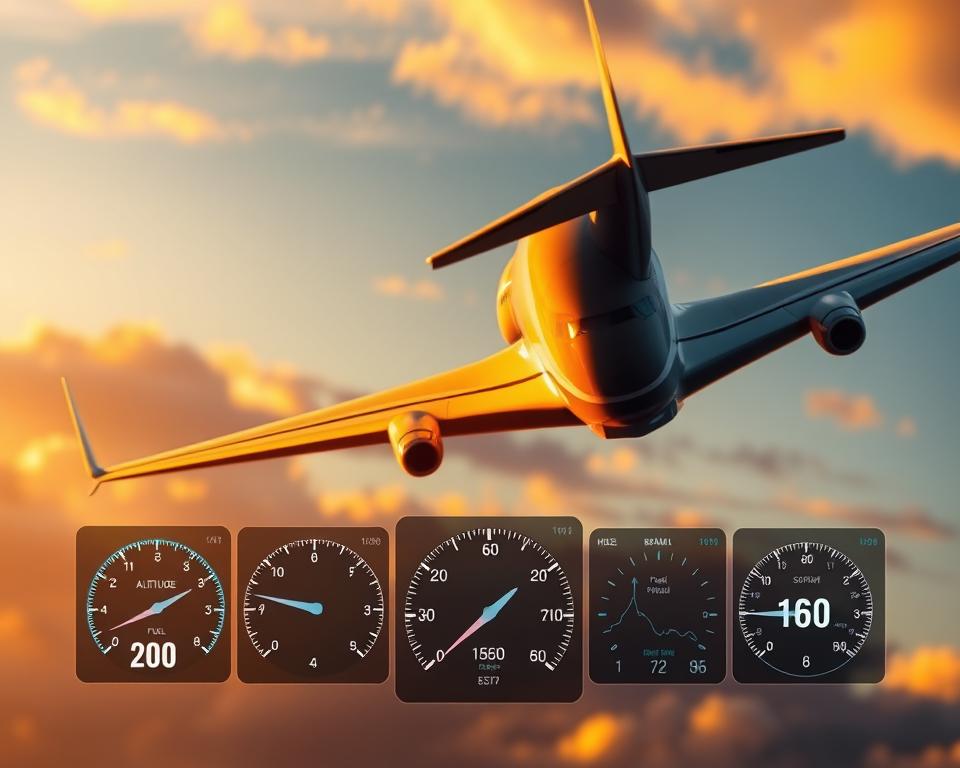
Flying at the optimal altitude saves you money. Projects like Green-GEAR They are looking for more precise profiles so that more devices can maintain their preferred level and reduce costs.
Direct routes vs. detours: impact on time and emissions
A shorter route usually saves time and fuel if the wind isn't a factor. But a detour due to weather or traffic congestion can be more efficient if it avoids long waits.
- Key metrics: liters/100 km/seat and kg CO2/passenger-km.
- Factors to monitor: wind, altitude, NOTAMs and flight phase.
- Good practices: continuous descents (CDA) and optimized ascents.
"One minute of waiting can cost liters of fuel and increase emissions."
Modern aircraft and their advances: 787, A350 and the new generation
Models like the 787 and the A350 They show how design and materials directly impact consumption.
Design and materials: from metal to composites
The new ones aircraft They use composites in the fuselage and wings to reduce weight. Less mass requires less thrust and less fuel.
This translates into longer flights with lower costs and a smaller footprint per seat.
Cabins and simple automation for efficient operation
Modern automation simplifies tasks without adding complexity. Clear systems help crews follow optimal flight profiles.
Fewer operational errors and more accurate profiles reduce consumption and costs. Passengers are already seeing CO2 estimates on search engines and comparison sites.
"Real reductions come from design, engines and procedures, not just marketing messages."
- Engines high by-difference and advanced aerodynamics.
- Less maintenance due to the compounds used and better comfort due to pressure control.
- Deciding to renew the fleet can lower operating costs and the cost per passenger.
Engines and aerodynamics: high bypass ratio, winglets and more
The combination of engine and wing It defines a large part of the real savings. Here I explain, in simple language, why it works.
Why large engines can consume less
High-bypass engines use a larger fan that moves a lot of cool air around the core. This generates the same thrust with less energy expenditure and reduces noise.
Less fuel consumption per boost means less fuel used per kilometer. In addition, a large fan improves responsiveness without increasing overall consumption.
The wingtips cut through the vortices that create induced drag. Less drag translates to fuel savings during cruise.
Fewer engines, more range
The transition to twin-engine aircraft was made possible by more reliable engines. Today, certifications like ETOPS allow for long-haul routes with security and fewer emissions.
- A larger fan moves more cold air; that's the advantage.
- Winglets reduce vortices and drag; you save on every leg.
- The NEO and MAX families show practical improvements with new engines and wingtips.
Taken together, these advances improve the efficiency of the aircraft and lower operating costs without sacrificing safety.
aviation efficiency through air traffic management
New airspace control tools seek to adjust altitude with centimeter precision to save fuel and reduce noise.
Green-GEAR and SESAR: precise altitude for efficient descents and ascents
Green-GEAR (EU, 2024) Try switching from barometric altimetry to satellite geometric data. This allows for smoother descents, less time spent at high engine power, and nearly continuous profiles.
Reduced vertical separation and preferred levels
If accuracy is validated, the vertical separation can be reduced. This allows more aircraft to maintain their ideal altitude.
Result: greater airspace capacity and lower cost per flight.
Incentives to use cleaner routes
They are studying rates that penalize costly detours and reward direct and less polluting routes.
- Continuous downhill speeds (CDA) that save fuel.
- Silent approaches near airports.
- Simulations and workshops before any real changes.
"Safety is paramount: every innovation is rigorously validated before going into operation."
These ideas impact punctuality and predictability. You can assess their maturity by looking at local tests and simulation results.
Fuel and the future: SAF today, hydrogen and electricity in the long term
Today, there are real options for reducing emissions.But each one has clear limits and different deadlines.
SAF and compatibility with current fleets
The SAF It is mixed with Jet A-1 and can be used in current engines without major modifications.
It reduces life cycle emissions compared to fossil fuels, although supply is low and price is higher.
Hydrogen and batteries: a realistic outlook
Hydrogen requires redesigns of aircraft fuselages, logistics and fuels at airports; its commercial deployment could take decades.
Batteries are improving, but their density limits long flights for now.
What do climate projects say?
Project Drawdown places SAF and hydrogen in "Keep Watching": high potential, but lacks scaling and economic testing.
"Operational efficiency remains the immediate lever as these solutions grow."
- Understand reductions by life cycle, not just by tank.
- Long-term contracts and blending mandates activate supply.
- For short routes, use electric vehicles; for medium routes, use SAF; for long routes, improve operational practices.
Fleet and route strategy: the A321XLR case and efficient long-haul flights
The A321XLR redefines how airlines connect medium-sized cities without relying on hubs. With additional fuel tanks and aerodynamic improvements, this model allows point-to-point routes that previously required a widebody.
New point-to-point routes and seasonal optimization
During peak season, a widebody aircraft remains useful in terms of capacity. However, during off-peak months, two A321XLRs can meet demand with similar operating costs and lower fuel consumption per flight.
This favors direct routes between mid-sized airlines: think of it as more direct flights and fewer long connections. It also improves load factors and reduces empty seats.
Comparisons of fuel consumption and profitability versus widebodies
Practical comparison: On flights of 6–9 hours, the A321XLR typically exhibits lower hourly fuel consumption than legacy widebody aircraft. In total cost, you save on crew, fees, and maintenance for low-demand missions.
"Two well-managed narrowbodies can be more profitable than a single widebody in weak seasons."
- Direct routes between medium-sized cities become viable.
- Better capacity adjustment and higher occupancy in the low season.
- Risks: limited alternatives, weather and ETOPS requirements.
To decide, compare seat consumption, unit costs, and the flexibility of codeshare agreements that feed the route. This will help you determine when a long-haul narrowbody makes operational and financial sense for your network.
Operations and safety: procedures that conserve fuel
Good planning reduces unnecessary detours and saves fuel right from the doorstep. Before takeoff, a clear route and weight plan helps you stay on schedule and reduce consumption.
Flight planning, descent profiles, and weight management
Flight plan: It uses real-time data to choose routes and altitudes that avoid headwinds and congestion.
Continuous profiles: Continuous descent and optimized ascents reduce time and noise. Green-GEAR validates these profiles with simulations.
Weight management: Check payload and distribution. Less mass reduces fuel consumption and improves range.
Safety first: efficiency without compromising margins
Safety comes first. Legal reserves are always maintained: extra fuel for weather and alternatives is not negotiable.
"Clear briefings and performance data prevent inefficient maneuvers and operational risks."
- Single-engine taxi and APU vs. GPU depending on local procedure.
- Pre-flight briefings that include ATC and weather alternatives.
- In-flight monitoring to adjust profile and save time.
Result: Real improvements without sacrificing safety margins. By implementing these practices, you'll see fewer delays and lower fuel consumption per route.
Impact on costs, prices and the low-cost model
When an airplane reduces its fuel consumption per seatThe airline saves money on each flight. These savings can translate into more routes, higher frequencies, or temporary promotions, depending on the business strategy.
The efficiency operational aspects also favor standardization of fleetsHaving similar models reduces maintenance and training. This lowers fixed costs and improves financial predictability.
In the low-cost model, the benefits arise from combining low fuel consumption, fast turnarounds, and high daily occupancy. This dilutes the cost per seat and allows for price competition without sacrificing profitability.
- Fuel consumption directly impacts the cost per seat.
- Lower spending frees up room for new frequencies or promotions.
- Point-to-point routes reduce connection times and operating costs.
- Fuel contracts and hedges stabilize prices against volatility.
"Final prices depend on demand, competition and regulation, not just fuel."
Keep in mind that airport fees, congestion, and regulatory changes can offset some of the savings. Assessing when to renew the fleet or upgrade engines requires comparing capital costs, expected savings, and macroeconomic risks such as oil price volatility.
Jobs and training: pilots, crews and skills of the future
New fleets don't just modify the aircraft; they transform the routines and skills required.
Manufacturers like Boeing and Airbus They maintain a similar cockpit philosophy to facilitate the transition between models. This reduces lengthy retraining and accelerates commissioning.
But the biggest difference lies in the mindset: today, an operational culture that prioritizes fuel savings and data-driven decisions.
The expansion of routes using long-range narrowbody aircraft demands new fatigue and fuel management practices. Ongoing training in performance and procedures is key.
- Operational familiarity for model changes without losing safety.
- Increased use of flight analytics to optimize profiles and planning.
- Cabin crew: quick turnarounds, efficient service and safety.
- New job opportunities through expanded bases and routes.
- A culture of reporting and continuous improvement to sustain real improvements.
"Constant training and a practical mindset make the difference between cosmetic changes and improvements that truly require training."
Learn to distinguish terms Operations that require real retraining in response to minor changes. This will protect your career and contribute to the common goal: flying with greater efficiency and safety.
Metrics that matter: how to read emissions and consumption data
Knowing which numbers to look at saves you time and prevents you from drawing incorrect conclusions about emissions.
- L/100 km per seat: shows relative consumption by capacity.
- CO2/pax-km: It estimates the footprint per passenger and facilitates comparisons.
- ASK, RPK and load factor: They reveal network efficiency, not just the efficiency of a single flight.
How to compare aircraft and fleets with sound judgment
Don't just compare catalog numbers. Performance changes depending on wind, ATC profiles, and route.
Check: Seat configuration, fleet age, and maintenance. These factors influence actual fuel consumption.
Keep safety in mind: Legal reserves, alternates and waiting periods increase emissions and should be included in your calculation.
"Always ask for the methodology and assumptions behind any CO2 estimate."
Quick template for comparing routes and fleets:
- Origin-Destination, distance and profile (cruise/descent).
- L/100 km/seat estimated and CO2/pax-km actual.
- ASK/RPK and expected load factor.
- Average age of the fleet and maintenance practices.
- Fuel margins for safety and possible alternatives.
Result: With this data you can detect greenwashing and choose routes or suppliers with better management practices and lower fuel consumption.
Conclusion
Conclusion
Beyond technologyThe immediate priority is to improve how flights are operated daily to achieve real savings.
The industry contributes approximately 2.51 trillion tons of energy-related CO2; projects such as Green-GEAR and SESAR show short- and medium-term benefits. Project Drawdown identifies these improvements as priorities while SAF and hydrogen mature.
Prioritize comparing aircraft using clear metrics: fuel consumption per seat, CO2/pax-km, and route profiles. Review assumptions about time and emissions published by search engines and request verifiable sources.
Consult authorities, manufacturers, and official studies before making a decision. Every operational adjustment adds liters and reduces impact; maintain realistic expectations regarding timelines and continue measuring to improve.