Advertisements
Can you imagine a flight where you choose the lighting, privacy, and even the type of seat according to your work rhythm?
In a few years you experience Air travel will change radically. Airlines are betting on a new design. passenger-centric which brings private pods, family areas and modular workspaces.
You'll find ergonomic and adjustable seats, LED lighting that helps with jet lag, and connectivity that makes streaming seamless. All of this is designed to give you more comfort and control during every trip.
Thousands of innovations are converging: IoT for personalization, VR/AR for testing layouts, and ultralight materials that reduce emissions. In addition, there are health improvements such as advanced filtration and antimicrobial surfaces.
In summary, the new cabin combines design and technology to make your travels better: more comfort, less wasted time, and a safer, more personalized experience.
Outlook 2025-2026: What's driving cabin redesign in the aviation industry
Regulatory and social pressure to reduce emissions It pushes the aviation industry to seek solutions that combine sustainability and profitability.
The Sustainable Aviation Fuels market has grown rapidly: it reached US$1.7 billion in 2024 and is projected to have a CAGR of 46.21% (2025–2034). Airlines such as Emirates and Etihad already use SAF on routes to Singapore, Amsterdam, London, and Japan. Furthermore, IATA maintains its commitment to achieving Net Zero Fly by 2050.
The industry is also incorporating disruptive technology. In 2024, Airbus tested autonomous taxiing, takeoff, and landing capabilities on its A350-1000. 3D printing reduces time and costs for interior manufacturing with on-demand parts.
Startups and manufacturers They are betting on AI, IoT, AR/VR, and blockchain to improve operational efficiency, user experience, and security. At the same time, regulation and costs remain key barriers to scaling changes in the sector.
- Sustainability priority: SAF, lightweight materials and optimized processes.
- Technological advances that enable new layouts and services in flight.
- Coordination between aerospace, airlines, and regulators determines the pace of change.
| Factor | Example | Interior Impact |
|---|---|---|
| Sustainability (SAF) | Emirates, Etihad; Fly Net Zero | Smaller footprint, changes in fuel logistics |
| Autonomy | Test A350-1000 (2024) | Operational redesign and new cabin configurations |
| Manufacture | 3D printing | On-demand spare parts, reduced downtime |
| Technologies | AI, IoT, AR/VR, blockchain | Customized services and predictive maintenance |
Airline cabin trends you should be watching right now
Today, passenger expectations are driving concrete changes in aircraft interior design.
The shift towards a focus passenger-first It features modular cabins, LED mood lighting, and ergonomic seating. You'll find touchscreen displays and integrated streaming to control lighting, entertainment, and services from your device.
In-flight connectivity is no longer optional. Stable Wi-Fi and native streaming sync your apps and enhance the experience. experience during travel and flights.
From comfort to “passenger-first”: how your expectations change
Airlines are investing in aircraft with configurable seats and optimized vertical storage. This allows you to customize your space according to the flight duration.
Milestones for 2025: connectivity, immersive reality, and sustainability
Immersive reality (VR/AR) is appearing in entertainment and briefings. IoT and technology enable the cockpit to anticipate preferences and perform predictive maintenance.
- Full control from screens: light, recline and services.
- Immersive entertainment synchronized with your content.
- Health measures: UV-C, antimicrobial surfaces and advanced filtration.
| Area | Impact | Benefit for the passenger |
|---|---|---|
| Connectivity | Native streaming | Fewer interruptions to your work and entertainment |
| IoT & AI | Preferences and maintenance | Faster service and fewer failures |
| Health | Filtration and ANC | Better air quality and less fatigue |
Passenger-centric design: experience, privacy, and choices you make
Airlines are creating spaces that respond to your pace, not the other way around. The new cabin design puts the passenger In control: real privacy, family areas and workspaces designed for your productivity or rest.
Personalized spaces: pods, family areas and workspaces
Modular cabins allow for private pods and family areas. This gives you privacy without losing connection with the rest of the flight.
Workspaces offer power outlets, tables and acoustic privacy so your travel combines work and comfort.
Ergonomic and configurable seats
The new seats improve posture and provide more legroom. Adaptive configurations reduce fatigue on long flights.
LED lighting and mood lighting
The lighting synchronizes with flight phases to adjust circadian rhythms and minimize jet lag. You choose the timing and intensity from the seat interface.
- Privacy and personalization: configurable pods and panels.
- Real comfort: lumbar support, plus legroom and recline control.
- On-demand services: food, lighting and discreet requests to the crew.
| Element | Benefit | What you will notice |
|---|---|---|
| Private Pods | Greater privacy | Silence and visual control |
| Ergonomic seats | Less fatigue | Better posture and rest |
| LED mood lighting | Less jet lag | Better sleep and adjusted sleep schedule |
Technologies that are reshaping the cabin: connectivity, IoT, AI, VR/AR and entertainment
The airplane cabin ceases to be just seats; it becomes an intelligent environment that responds to you.
In-flight connectivity integration enables stable Wi-Fi, native streaming, and synchronization with your devices. So your content and apps continue uninterrupted while you fly.
In-flight connectivity and streaming: your digital ecosystem in the air
Streaming enables continuity of work and entertainment. Aircraft networks reduce lag and support uninterrupted messaging and video.
Interactive interface and displays: light control, IFE and services
Touchscreens and integrated software give you direct control over light, recline, and IFE.
Quick options and intuitive menus simplify ordering and adjustments from your seat.
Smart interiors with IoT: personalized services and predictive maintenance
IoT sensors monitor the usage and status of components. This allows for customized services and predictive maintenance.
Suppliers such as Lufthansa Technik and type solutions Aircraft IoT They use analytics to avoid failures and improve punctuality.
VR/AR on board and in training: immersive experiences and training
Virtual and augmented reality enrich entertainment and accelerate crew training.
Digital twins and simulations reduce development times and improve skills retention.
- Systems integration transforms the cabin into a digital hub.
- IoT and AI support real-time maintenance and customization.
- 3D printing speeds up spare parts and reduces the weight of interiors.
| Technology | Example | Benefit for the passenger |
|---|---|---|
| Connectivity | Native streaming | Continuity of apps and fewer interruptions |
| IoT + AI | Lufthansa Technik / Aircraft IoT | Predictive maintenance and fewer delays |
| VR/AR | Eresha, digital twin (YVR) | Immersive entertainment and more effective training |
Sustainability and materials: towards a lighter, more efficient and circular cabin
The new generation of materials is transforming how much your next flight weighs and pollutes.
Bio-composites and recyclable components facilitate a responsible end-of-life for aircraft interiors. These materials reduce waste and allow for the recovery of parts at the end of their lifecycle.
Ultralight materials reduce overall weight and, therefore, fuel consumption on each flight. Fewer kilograms translate into fewer emissions and operational savings for the industry.
Integration with sustainable aviation and eco-design
The integration of eco-designed interiors and SAF operations is accelerating the transition to net-zero emissions. SAF is already showing growth (USD 1.7 billion in 2024; CAGR 46.21% for the 3-month period from 2025 to 2034), and airlines such as Emirates and Etihad are adopting it on key routes.
- Recyclability: parts designed for disassembly and recovery.
- Efficiency: less weight, less fuel and fewer emissions per flight.
- Integrated solutions: materials that maintain comfort and safety certification.
| Element | Benefit | Impact on sector |
|---|---|---|
| Bio-composites | Recyclable and lightweight | Better end-of-life management |
| Ultralight materials | Lower fuel consumption | Emissions reduction |
| Eco-design | Less waste | Integration with sustainable aviation |
This way, you'll experience changes in textures and finishes without sacrificing comfort. The industry is evolving to make your aircraft experience more responsible and efficient.
Health and well-being in flight: design solutions that take care of you
The next generation of interiors prioritizes measures that reduce contagion and noise so you can travel more peacefully.
Antimicrobial and UV-C surfaces: more safety, more confidence
Surfaces with antimicrobial coatings inhibit bacteria and fungi. This reduces risks without changing how you use the seats or tables.
The light UV-C It's applied in short cycles and disinfects common areas. As a passenger, you'll notice less chemical odor and greater confidence when touching armrests and screens.
Noise reduction and air quality
The materials and interior architecture reduce reverberation. In addition, many aircraft integrate Active Noise Cancellation (ANC) so you can rest or work without distractions.
Advanced filtration systems remove allergens and contaminants. The result is a cleaner environment and less fatigue during your travels.
- What you will see: less acoustic fatigue and a feeling of cleanliness when touching surfaces.
- How it integrates: These solutions operate discreetly within the cabin systems.
- Benefit for passengers: greater perceived safety and better rest on every flight.
| Element | Function | What you will notice |
|---|---|---|
| Antimicrobial coatings | They inhibit microorganisms | Safer surfaces |
| UV-C light | Rapid disinfection | Confidence when touching common areas |
| HEPA and ANC filters | They filter air and reduce noise | Fewer allergies and better concentration |
In the context of the aviationThese improvements complement ergonomic seating and lighting that respects your circadian rhythm, making your air travel experience safer and more comfortable.
Intelligent use of space: modularity, multipurpose and testing with virtual reality
The ability to reconfigure an aircraft in hours transforms operations and the passenger experience. Today, modular solutions allow the cabin to be adapted according to the flight duration and the profile of the travelers.
Modular cabins and partitions
Mobile partitions and modular kits facilitate rapid, on-demand reconfiguration. Thus, the same platform serves both short- and long-haul routes without structural changes.
Multi-functional areas
Collaborative tables, rest corners and concentration pods transform a single space into areas for working, socializing or sleeping.
VR for prototyping
Virtual reality allows for the validation of layouts and workflows before build. Testing reduces risks and shortens development cycles.
Adaptive seating and vertical space utilization
Adaptive seating maximizes density and comfort. Bins, pockets, and shelving optimize vertical storage without encroaching on your personal space.
- Modularity: Adjust the space to the route profile.
- Multipurpose: work, rest and socialization all in one flight.
- Software and training: tools that accelerate deployment and crew training.
| Element | Benefit | Impact |
|---|---|---|
| Movable partitions | Flexibility | Less aircraft downtime |
| VR prototypes | Rapid validation | Fewer errors in development |
| Vertical storage | More capacity | More open corridors and a better perception of space |
Safety, biometrics and evacuation: how design improves emergency management
The interior design now prioritizes clear evacuation routes that reduce panic. Signage and intuitive pathways shorten evacuation times and guide each passenger to safe exits.
Evacuation systems: signage and more intuitive routes
Light signals and escape routes are placed that are easy to follow even in poor visibility. This reduces stress and improves safety during an emergency.
Smart materials: fire-resistant and smoke-repellent
Fire-resistant coatings and smoke-repellent textiles They increase protection inside the cabin and meet aeronautical certifications. Less smoke means more time to evacuate safely.
VR simulations for protocols: faster crew decisions
The use of virtual reality in training allows for the recreation of real passenger reactions. The crew practices coordination and decision-making with data that is then used to adjust emergency systems.
- Biometrics at airports — such as vein scanning in Doha — streamlines the flow before the flight.
- Intelligent systems alert about smoke, temperature, and blocked exits.
- Everything is integrated while maintaining comfort and clear access for your daily safety.
| Element | Function | Benefit for you |
|---|---|---|
| Illuminated signage | Guide routes | Faster evacuation |
| Fire-resistant materials | Reduce spread | More safe time to go out |
| VR in training | Realistic simulations | More agile crew decisions |
Operational efficiency and costs: 3D printing, predictive maintenance and blockchain
The combination of 3D printing and real-time data is changing how a aircraft.
Additive manufacturing produces complex, lightweight interiors. Companies like Stratasys, 3D Systems, EOS, Ultimaker, and Norsk Titanium are reducing lead times. The A&D market grew to $2.88 billion in 2024 and is projected to reach $6.74 billion in 2029.
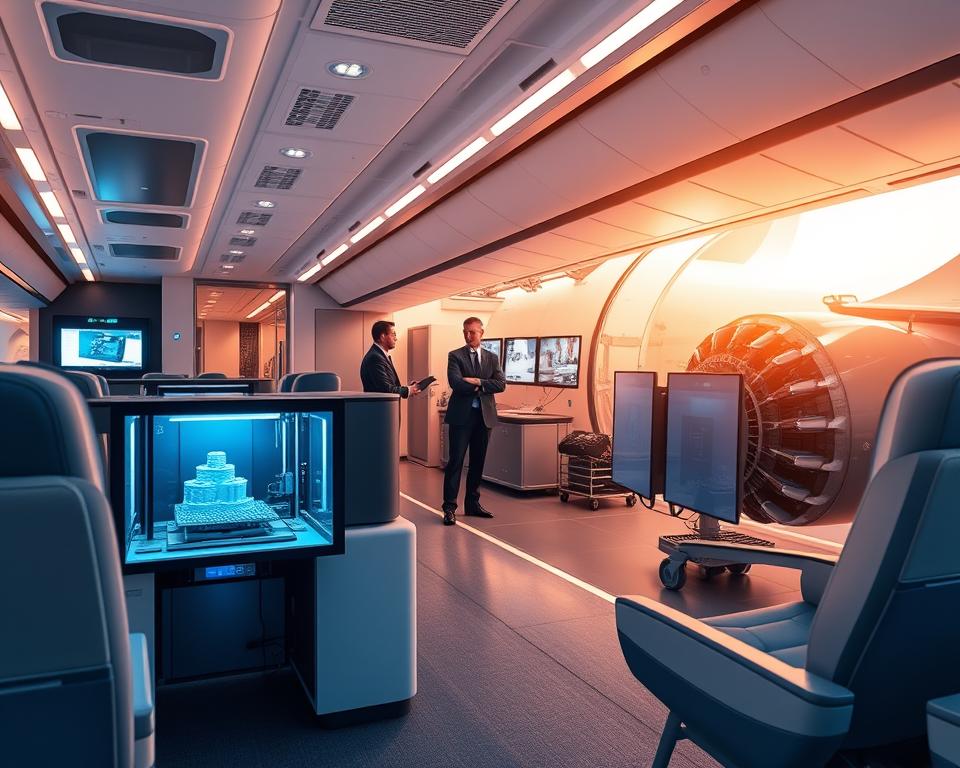
Additive manufacturing indoors
On-demand spare parts This means less inventory and less downtime. You get certified components faster and at a lower cost.
AI + IoT for maintenance
The combination of AI and IoT enables predictive maintenance. Lufthansa Technik already uses real-time visualization to detect faults before they affect flights.
Blockchain in retailing and tickets
Solutions like TravelX convert tickets into NFTickets using smart contracts. This provides traceability, control, and new revenue streams for companies. airlines.
- Lower immobilized inventory and reduction of costs.
- Improved MRO planning: materials, labor, and slots.
- Training and software accelerate adoption and change management.
| Solution | Example | Operational impact |
|---|---|---|
| Additive manufacturing | Stratasys, EOS, Norsk Titanium | Faster spare parts, less downtime, lighter weight |
| Predictive maintenance | Lufthansa Technik (AI + IoT) | Early detection, better efficiency and fewer delays |
| Blockchain in tickets | TravelX (NFTicket) | Traceability, direct revenue, and distribution control |
Conclusion
In short: the evolution of the cabins puts you Comfort and control first.
The real improvements come thanks to connectivity, IoT, AI, and VR/AR, which orchestrate smoother experiences and personalized services.
Sustainability is now a fundamental design element: lightweight, recyclable materials and the implementation of SAF reduce emissions without sacrificing comfort.
Health and safety are discreetly integrated: better air quality, less noise, healthier surfaces, and simulations that optimize evacuations.
Efficiency completes the cycle: 3D printing, predictive maintenance, and blockchain lower costs and accelerate solutions. You'll gain more choice, more control, and journeys that feel tailor-made for you, as the industry moves toward ambitious climate and operational goals.